Do you think it's possible to have a good novel without a plot?
Part of me thinks this is a ridiculous question, like is it possible to make a cup of tea without water? or is it possible to get through a British summer without rain? But a small part of me has long felt that it ought to be possible to write a novel without a plot, because novels are meant to engage with reality (even books about aliens or talking rabbits), and real-life is not notable for its coherent plot lines.
Scarlett Thomas deals with this question brilliantly in Monkeys with Typewriters: How to Write Fiction and Unlock the Secret Power of Stories. She argues that just because novels (like film, theatre and other forms of fiction) deal with life, it doesn't mean that they offer facsimiles of everyday existence, and those that attempt to do so just don't work. She goes on to contrast the films Gentlemen Prefer Blondes and There's No Business Like Show Business, and shows how the former works because in it actions have consequences, which lead by a circuitous route to a satisfying conclusion, while the latter does not work because it rambles along from one random event to another, relying on things like car accidents, unmotivated alcohol addiction and un-loveable characters being loved...in fact, just the kinds of things that occur all the time in real life. In other words, you've got to follow the 'rules' of storytelling if you want to create an exciting and original story. Throw the rules out of the window and you're likely to end up with something shapeless and boring.*
This came as a revelation to me, and I kind of knew it was true whilst kind of wanting it to not be, on account of a subliminal fantasy, long-harboured, in which I stun the world with a Proustian** epic about people loafing about having psychologically-revealing thoughts. I was beginning to wonder why this wasn't working for me, and why it was proving so much easier to write about evil godfathers, talking owls and feisty girls on quests. At least Scarlett Thomas's argument provided me with a respectable explanation.
I thought I'd caught her out though when I got obsessed by the Cazalet Chronicles by Elizabeth Jane Howard - a series of five doorstopper-sized volumes which manage to be utterly compelling whilst dealing with nothing more, and nothing less, than the domestic lives of a large family. It was only when I finished the final volume a few weeks ago that I thought it over and realised it does have a really intricate plot structure, although its so cleverly made that you can't see it, and sometimes you feel you are reading a series of incisive character vignettes. The whole thing is driven by many of the age-old principles of storytelling: love is shown to be it's own reward, selfishness shrivels the soul, happiness and goodness turn out to be much the same thing...It's tempting to dismiss these as clichés when I write them out as baldly as that, but aren't they some of the ultimate truths that we demand even from out most sophisticated stories, and hope against hope to rediscover in real life?
* You might say, Rules, what rules? but they do exist, and I'm not talking about any narrow-minded, nit-picking, how-to-write tips of the "never-use-more-than-one-adjective" variety. Think about it: can Elizabeth Bennett drop down dead in the middle of dancing a minuet with only ten pages to go before her long-awaited happy ending? It could happen in real life but in the romantic comedy world of Pride and Prejudice it is impossible, AKA, 'against the rules,' and if Jane Austen had gone and done it we would be justly outraged (not that she'd ever have found a publisher).
** À La Recherche du Temps Perdu does have a plot actually, but it unfolds at such a glacial pace that one might be forgiven for thinking it didn't.
Friday, 16 January 2015

Wednesday, 3 December 2014
Story-Writing Similes (What DID I do to that plant?)
If someone asked you to give them a sense of what it is like to write a story, what would you say? How would you describe the creative process? If you were to use an allegory, what would it be?
As you will know if you've read this blog more than once, there are many idle questions bumbling in and out of my brain, but this is a recurring one (I don't quite know why. Navel-gazing, maybe? Writers are good at that) so I think they deserve a post. Here are a few of my own ideas:
Writing a story is like making a sculpture from a block of stone. You have a mass of ideas in your head, perhaps even on paper in the form of a chaotic first draft. This equates to the rugged block of marble with which Michelangelo stands face to face first thing on a Monday morning. He takes up his chisel; you take up your ballpoint pen. He chips, smooths and twizzles away at the rock until David materializes. You chip, smooth and twizzle away at your lump of words until your story stands revealed in all its splendour.
Writing a story is like embarking on an archaeological dig There are protuberances in the landscape of your mind that make you suspect there's a buried story there. You've even found the odd clue: characters, scenes and conversations have cropped up in your head the way coins, axe-heads and Anglo-Saxon belt-buckles sometimes do in lowly stretches of English farmland. You start digging, sifting and making sense of things. You dream that your story will be the literary equivalent of Sutton Hoo.
Writing a story is like growing a plant Just like a plant, a story needs to be nurtured over time; it can't be forced in the space of a few days. You need to let it take root in your mind and nourish it with lots of thought and reading. As someone who has inadvertently killed many plants and stories in her time, my advice would be to try and tread the thin line between excessive cherishing and vile neglect. A story that just won't come right, and seems to get worse the more you tinker and polish and fret, is as doomed as an over-watered pot of basil. Likewise, the story you can't really be bothered to write will end up friable, parched, moulting and brownish in colour.
Writing a story is like getting to know someone Unless you're lucky enough to experience love at first sight, you and your story will probably start off as polite acquaintances. You might progress to friendship, you might not. You might decide that you really don't like each other and you never want to meet again, in which case you should scan the room for a new narrative plan (ooh yes, what about that one over by the bar, the one that looks like a cross between Mr. Rochester and Sherlock Holmes?) and move on. Once you've made your move and had a few coffees together it is to be hoped that you will fall in love. You may enjoy a calm, happy kind of relationship. You may experience periods of euphoria punctuated by the most appalling quarrels. Just as long as you're in love I'm not sure that it matters.
If anyone else has ways of thinking about what it's like to write a novel, please let me know. It's years since I had a collection (and my Worldwide Stamp Album was a bit of a non-starter anyway, what with my most far-flung correspondent living in Suffolk), so it would be nice to make one now. A Collection of Story Writing Similes. All donations welcome.
Tuesday, 4 November 2014
A Sense of Place (and some)

If you are looking for a masterclass in creating a sense of place, please can I strongly recommend Hannah Kent's debut novel, Burial Rites. (The only downside to this book is the look you get when someone says, "Ooh, what are you reading?" and you reply, "Oh..er...it's called Burial Rites." They shrink away with a funny expression and assume you're up to your ears in a gore-fest. But that's by the by.)
As a writer, it's taken me a while to grasp the importance of creating a strong sense of place. I've been through phases of thinking that a tight plot is what matters most, or flow, or theme, or characterisation, but for a long time 'sense of place' came low on my list.* I think I worried that it meant writing the kind of long, boring, descriptive passage that can be airlifted out of chapter three and dropped into the middle of chapter 56 without affecting the story one way or another. Is there anything more tedious than a book which begins :"The manufacturing town of X lay in a long valley in the county of Y, twelve miles from the city of Z with which it was connected by a road and a railway. In the year in which our story opens, the population exceeded twenty thousand...."? Is there anything more mind-numbing than an exhaustive description of the layout of a house, which will probably be crucial to the plot (because if you're not 100% sure that the library is the second room on the left as you come down the stairs and therefore adjacent to the dining room and opposite the parlour, then how can you possibly visualise Cecily hiding behind the door in the music room with a perfect view of the hall mirror, in which she will witness Albert and Gertrude kiss/conspire/cudgel one another?), but which you just can't (be bothered to) picture in your mind's eye.
Hannah Kent does not indulge in this kind of information-dump-disguised-as-descriptive-passage. The place where she has set her fact-based novel - 1820s Iceland - is not an add-on to be hurried through in an opening chapter before the actual story can begin. (The opening sentence is, "They said I must die", which a lot more arresting and novelistic than any topographical fact, even one that concerns a country as exciting as Iceland.) Sense of Place weaves in and out of Burial Rites like a black thread in a sombre tapestry. Sometimes Hannah Kent's Iceland becomes the story; sometimes it is a character in its own right; always it sets the grim, haunting and oddly humane tone. It is never inert; never a flat backdrop. Without the mists, the snows, the howling winds, the smell of the sea, and the crouching farm buildings, the progress of the seasons and the rituals of the farming year, there wouldn't be a novel.
I wish I could create such a strong and pervasive fictional place. This is a truly inspirational book. Here's a taste:
"I'm not sure why I opened the door to look outside. I suppose I was curious. But some strange compulsion took me and I unlocked the latch to peek out at the weather.
It was an evil sight. Dark clouds bore down upon the mountain range and under their smoky-blackness, a grey swarm of snow swirled as far as you could see. The wind was fierce, and a great icy gust of it suddenly blew against the door so hard that it knocked me off my feet. The candle on the corridor wall went out in an instant, and from within the croft Bjorn shouted what the Devil I thought I was doing, letting the blizzard into his home.
I heaved against the door to shut it, but the wind was too strong. My hands stiffened with the cold rush of air. It was as though the wind was some form of ghoul demanding to enter. Then, all of a sudden, the wind dropped, and the door slammed shut. As though the spirit had finally entered and closed the door behind it."
* As for whether it's intelligent to think of such things in terms of hierarchies, that's another question, to which I'm pretty certain the answer is 'No'.
Thursday, 2 October 2014
'Why I do what I do' Blog Tour
It's always a good idea to stop what you're doing from time to time and ask yourself why on earth you're doing it, so I'm really grateful to Heidi Chandler for inviting me on this blog tour. Heidi is a busy mother and writer, whose first book, Holding Avery: A Memoir was published by MP Publishing in 2014. Please take a look at her fabulous website here: http://heidichandler.com/
So why do I do what I do?
(i.e. for the purposes of this blog tour, write). I was mulling it over from behind a pile of clean laundry this afternoon and got so absorbed by possible answers that I practically welded a tea towel to the ironing board. This is a boundless question. If I gave my inner-narcissist free reign I could spend the rest of my life musing about why I write, but for the sake of everyone's sanity, not least my own, I will try to be concise.
I write to escape...
When I was a kid I loved reading books because they provided me with places to run away, hide and have adventures. When Lucy opens the wardrobe door onto Narnia, it always seems to me that symbolically she is opening the front cover of a story book. When you open up a book you are opening a door onto another world, and when you step inside you do so knowing that anything might happen. If that's what a book is - a door into another world - then how could I not want to write one?
By the way, when I say that as a kid I wanted to 'run away' and 'hide' I don't mean that I was unhappy in the real world. Not at all - I grew up in a wonderful family and I had a wonderful childhood. But I was very shy, and interacting with the real world was sometimes an effort, especially during my teens. That's where fictional characters came into their own for me: I could love them, hate them, know them, be them, through and through, even if I could only raise a unsmiling little mumble in my dealings with actual flesh-and-blood people. I bet a lot of writers were once introverted children in need of sanctuary, who became addicted to the kind of companionship that only fictional characters can provide.
But I also write to communicate...
Yes, okay, it's fine for a shy child to seek refuge in her imagination. But if being a writer means spending your entire life in flight from reality, isn't that...well...a bit sad?
Ah, but you see, the moment I start turning my internal world into prose, it means I want to connect with other people. I may not necessarily realise that that's what I want, but it is. Fourteen year old Elizabeth may think that she would die a thousand deaths before she ever, ever, ever let anyone read her diary, but if that's really true then why is she writing it? Doesn't she actually fantasise about a kindred spirit discovering it, and reading it, and understanding her like nobody's ever understood her before...?
When I talk about exploring other worlds, I don't necessarily mean Fantasy Worlds with a capital F and a capital W. All stories take you to a new world, even if they're set in your own home town among the kind of people you meet every day. The mind of a made-up character is as much another world as Narnia or Hogwarts, and fictional minds are the only kind of minds a writer can explore unreservedly, without fear that she might be trespassing or looking at things the wrong way. I couldn't turn a real person's mind inside out and shake it all about - it wouldn't feasible or morally right - but I can do it to a fictional character.
In other words, when I write I want to engage with my fictional creations at as a deep a level as possible, and then communicate what I find to other people. For me, that sums up the thrill of writing, and I hope it explains why I do what I do. It's a start, anyway.
Or, to put it more succinctly...
The psychologist D.W. Winnacott wrote that there is a conflict in most writers between two needs:
"The urgent desire to communicate, and the still more urgent need not to be found."

Now it's my turn to pass the baton on, and I would like to nominate Marguerite Madden to write about why she does what she does. Please take a look at her fantastic (musical!) website here: http://margueritemarkiemadden.simplesite.com/411391806
Marguerite Madden (Markie to friends and family) was born on August 19, 1975, in Midland, Texas. She married in 1994, and has two daughters.
In 2012, Markie published her first book, Once Upon a Western Way for e-reader platforms such as Nook, iPhone and Kobo.
The following year Markie was diagnosed with leukemia (AML), and was hospitalized far from home for treatment. During this time, she reconnected with Denise (Mercer) Blackwell, an old friend from high school who is also a published author who convinced her to publish in print and for Kindle e-readers through a web-based service called Create Space. Her book, Keeping a Backyard Horse, went live for print on September 1, 2014.
Markie is currently a member of an online writer's group called Scribophile, a group of writers dedicated to helping one another to improve their work.
So why do I do what I do?
(i.e. for the purposes of this blog tour, write). I was mulling it over from behind a pile of clean laundry this afternoon and got so absorbed by possible answers that I practically welded a tea towel to the ironing board. This is a boundless question. If I gave my inner-narcissist free reign I could spend the rest of my life musing about why I write, but for the sake of everyone's sanity, not least my own, I will try to be concise.
 |
| Hmm....Where was I? |
I write to escape...
When I was a kid I loved reading books because they provided me with places to run away, hide and have adventures. When Lucy opens the wardrobe door onto Narnia, it always seems to me that symbolically she is opening the front cover of a story book. When you open up a book you are opening a door onto another world, and when you step inside you do so knowing that anything might happen. If that's what a book is - a door into another world - then how could I not want to write one?
By the way, when I say that as a kid I wanted to 'run away' and 'hide' I don't mean that I was unhappy in the real world. Not at all - I grew up in a wonderful family and I had a wonderful childhood. But I was very shy, and interacting with the real world was sometimes an effort, especially during my teens. That's where fictional characters came into their own for me: I could love them, hate them, know them, be them, through and through, even if I could only raise a unsmiling little mumble in my dealings with actual flesh-and-blood people. I bet a lot of writers were once introverted children in need of sanctuary, who became addicted to the kind of companionship that only fictional characters can provide.
But I also write to communicate...
Yes, okay, it's fine for a shy child to seek refuge in her imagination. But if being a writer means spending your entire life in flight from reality, isn't that...well...a bit sad?
Ah, but you see, the moment I start turning my internal world into prose, it means I want to connect with other people. I may not necessarily realise that that's what I want, but it is. Fourteen year old Elizabeth may think that she would die a thousand deaths before she ever, ever, ever let anyone read her diary, but if that's really true then why is she writing it? Doesn't she actually fantasise about a kindred spirit discovering it, and reading it, and understanding her like nobody's ever understood her before...?
When I talk about exploring other worlds, I don't necessarily mean Fantasy Worlds with a capital F and a capital W. All stories take you to a new world, even if they're set in your own home town among the kind of people you meet every day. The mind of a made-up character is as much another world as Narnia or Hogwarts, and fictional minds are the only kind of minds a writer can explore unreservedly, without fear that she might be trespassing or looking at things the wrong way. I couldn't turn a real person's mind inside out and shake it all about - it wouldn't feasible or morally right - but I can do it to a fictional character.
In other words, when I write I want to engage with my fictional creations at as a deep a level as possible, and then communicate what I find to other people. For me, that sums up the thrill of writing, and I hope it explains why I do what I do. It's a start, anyway.
Or, to put it more succinctly...
The psychologist D.W. Winnacott wrote that there is a conflict in most writers between two needs:
"The urgent desire to communicate, and the still more urgent need not to be found."
Now it's my turn to pass the baton on, and I would like to nominate Marguerite Madden to write about why she does what she does. Please take a look at her fantastic (musical!) website here: http://margueritemarkiemadden.simplesite.com/411391806
Marguerite Madden (Markie to friends and family) was born on August 19, 1975, in Midland, Texas. She married in 1994, and has two daughters.
In 2012, Markie published her first book, Once Upon a Western Way for e-reader platforms such as Nook, iPhone and Kobo.
The following year Markie was diagnosed with leukemia (AML), and was hospitalized far from home for treatment. During this time, she reconnected with Denise (Mercer) Blackwell, an old friend from high school who is also a published author who convinced her to publish in print and for Kindle e-readers through a web-based service called Create Space. Her book, Keeping a Backyard Horse, went live for print on September 1, 2014.
Markie is currently a member of an online writer's group called Scribophile, a group of writers dedicated to helping one another to improve their work.
Wednesday, 17 September 2014
The Work in Progress (WIP) Blog Tour
I'm delighted to have been invited to join the "Work in Progress" blog tour by my friend and fellow author, Colleen Story. Colleen is a prize-winning author of novels, poems, short-stories, and she also writes articles and research-papers specializing in health and wellness. Colleen writes speculative fiction in both the young adult and adult literary genres. Her fantasy novel, Rise of the Sidenah, is forthcoming in 2014 from Jupiter Gardens Press (under the pen name “C. Shay Ryander”) and her literary novel, Loreena’s Gift, is forthcoming from Dzanc Books in August 2015. She is also the founder of Writing and Wellness, a robust informational blog with author features and articles on topics like staying healthy while writing, finding your own voice, and managing the ups and downs of a writer’s life. You can read her WIP post (including some good advice on self-belief from Rocky III) here:
http://www.writingandwellness.com/2014/09/16/facing-the-truth-about-your-wip-advice-from-rocky-iii/
The rules of the WIP blog tour are as follows: provide the link back to the post by the person who nominated you, write a little about and give the first sentences of the first three chapters of your current WIP, then nominate four other writers to do the same.
So, here we go: The Weir House was supposed to be a short story but it grew into an historical/time-slip novel for adults and the current draft stands at about 80,000 words. The Weir House is the story of two Victorian sisters as they struggle to break free from their father's oppressive household, and the woman who is haunted by their story over a century later. The two parts of the novel - Victorian melodrama and twentieth-century ghost story - weave in and out of one another throughout the book.
Here are the first sentences from the first three chapters:
Chapter 1: The front door slammed shut with such violence that the frame quivered, and the whole house with it. Maria lifted her face to the rain, astounded by her own resolve.
Chapter 2: It was just like Bea to take the heat-wave personally. It might have consoled her to know that the rest of England was suffering too, but Bea never bothered with TV and she didn't think of it like that.
Chapter 3: Mrs. Betsy Fleet arrived at the Weir House by stealth. She sent the driver to the front door with her luggage, while she stole up the cobbled lane, between high walls and lime trees, to the garden gate.
I'm nominating the following amazing writers to reveal their WIPs:
Kerri Cuevas http://www.kerricuevasbooks.com/
Heidi Chandler http://heidichandler.com/
Aviva Orr http://www.avivaorr.com/
Rakie Keig http://rakiekeig.blogspot.com/
Please take some time to look at their websites, blogs and books!
Friday, 12 September 2014
Two and a half days in Berlin (July 30th-August 2nd, 2014)
If someone challenged me to set a novel in an unfamiliar city of my choice, and then paid for me to live in said city for a year or two while I conducted my research (a less than likely scenario, but such is the aspiring-writer's fantasy life), then I might well choose Berlin. You don't need to be there for many hours, or delve too deeply, to be aware of the bruising it's had from the hands of history - twentieth century history in particular. Look, for example, at the books available in English at the Berlin Historiale Museum shop: Goodbye to Berlin by Christopher Isherwood, Alone in Berlin by Hans Fallada, A Woman in Berlin April-June 1945 by an anonymous diarist, The Spy Who Came In From The Cold by John le Carré, A biography of Eva Braun, several accounts of Hitler's final days...all very different books, I know, but you must admit they have a certain hard-boiled quality in common. There's a definite lack of rom-com.
On our first afternoon we went on an open top bus tour round all the classic sights: the Reichstag, the Brandenburg gate, Checkpoint Charlie etc. We'd been negotiating airports since six o'clock, which is why I kept nodding off and jolting awake as the bus trundled with a soporific sort of sway through the July streets. As a result my initial impressions were broad-brush, rather startled and almost entirely lacking in factual information. "My impressions of the city after being here four hours or so," I reported dozily to my diary later on. "Heavy & megalithic rather than charming or pretty, still a strong sense of Damage despite (or because of) all the new, shiny buildings. Painfully steeped in history, so many resonant names (Potsdamer Platz, Unter den Linden, Spandau, Wannsee...), resonant buildings, resonant gaps between buildings, resonant ruins. There was a clap of thunder at one point. The bells in the bomb-damaged Gedächtniskirche rang at half-five sounding deep and mournful (I was going to say resonant again but think I need a new word)."
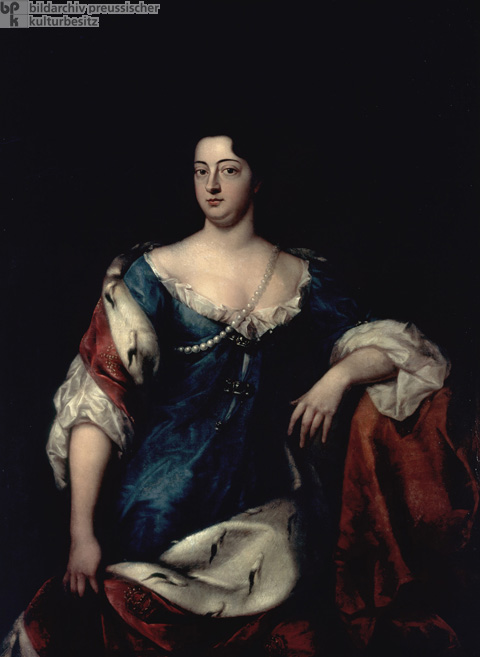 |
| Queen Sophie Charlotte and her interesting chin |
 |
| Our Isherwood-esque sitting-room |
I'm glad we stayed in that characterful flat and not a could-be-anywhere-in-the-world hotel. It was kitted out with all sorts of odds and ends of furniture - some antique, some plain, some just strange (the non-functioning Bakelite television). Its proportions were big-going-on-majestic compared to most modern flats, as were the double doors that led from room to room, and the ornate mouldings on the ceiling, but there was a vertiginous flight of stairs inside the bathroom door, which made me a bit uneasy about nocturnal trips to the loo, and the walls were papered with woodchip.
 |
| The Toothpick |
Me: Look, that's the television tower, the tallest structure in Germany!
S: Mmm. Can we go back now?
Me: 368 metres high. Wow. It's nicknamed 'the Toothpick.'
S: You do still have my tram safe in your handbag, don't you? Can I just look at it for a teensy second?
Thursday, 14 August 2014
The Dead Hand of Recommendation
In my last post I concluded by raving about Michelle Paver's Dark Matter, and that got me thinking about the problems that come with recommending books. What problems? I hear you say - probably because you have a life to lead and don't allow yourself to get unduly disturbed by life's lesser paradoxes.
Nevertheless, I can't be the only person in the world to have noticed that a gushing book recommendation nearly always results in disappointment. Even if the book in question is good, a teensy bit of frustration seems all-but-inevitable, especially if you're a gullible type who's liable to take other people's effusions very literally. "Your life will never be the same after reading this book", affirms the Arts & Books section of the Saturday paper, so I go to extraordinary lengths to obtain said book and turn to page one with palpitating heart, bidding a fond farewell to my old life as I do so, only to emerge two hundred and forty seven pages later feeling a little flat and thinking "...oh."
On the other hand, being in love with a book is like being in love with a person: cautious language feels pathetic and cold and altogether inadequate. You don't want to say "Hmm..." when you're really thinking, "Yes! Yes! Yes!" so you don't - can't - hold back in your praise. Phrases like "eye-poppingly, mind-bogglingly stupendous" suddenly seem quite tame, and as a result your inflamed listener goes to extraordinary lengths to obtain said book and turns to page one with palpitating heart, bidding a fond farewell to their old lives as they do so, only to emerge two hundred and forty seven pages later feeling a little flat and thinking "...oh."
I suppose there are worse things to lie awake fretting over.
Subscribe to:
Posts (Atom)