Thursday, 2 October 2014

'Why I do what I do' Blog Tour

It's always a good idea to stop what you're doing from time to time and ask yourself why on earth you're doing it, so I'm really grateful to Heidi Chandler for inviting me on this blog tour. Heidi is a busy mother and writer, whose first book, Holding Avery: A Memoir was published by MP Publishing in 2014. Please take a look at her fabulous website here:  http://heidichandler.com/


So why do I do what I do?

(i.e. for the purposes of this blog tour, write). I was mulling it over from behind a pile of clean laundry this afternoon and got so absorbed by possible answers that I practically welded a tea towel to the ironing board. This is a boundless question. If I gave my inner-narcissist free reign I could spend the rest of my life musing about why I write, but for the sake of everyone's sanity, not least my own, I will try to be concise.


Hmm....Where was I?


I write to escape...

When I was a kid I loved reading books because they provided me with places to run away, hide and have adventures. When Lucy opens the wardrobe door onto Narnia, it always seems to me that symbolically she is opening the front cover of a story book. When you open up a book you are opening a door onto another world, and when you step inside you do so knowing that anything might happen. If that's what a book is - a door into another world - then how could I not want to write one?

By the way, when I say that as a kid I wanted to 'run away' and 'hide' I don't mean that I was unhappy in the real world. Not at all - I grew up in a wonderful family and I had a wonderful childhood. But I was very shy, and interacting with the real world was sometimes an effort, especially during my teens. That's where fictional characters came into their own for me: I could love them, hate them, know them, be them, through and through, even if I could only raise a unsmiling little mumble in my dealings with actual flesh-and-blood people. I bet a lot of writers were once introverted children in need of sanctuary, who became addicted to the kind of companionship that only fictional characters can provide.


But I also write to communicate...

Yes, okay, it's fine for a shy child to seek refuge in her imagination. But if being a writer means spending your entire life in flight from reality, isn't that...well...a bit sad?

Ah, but you see, the moment I start turning my internal world into prose, it means I want to connect with other people. I may not necessarily realise that that's what I want, but it is. Fourteen year old Elizabeth may think that she would die a thousand deaths before she ever, ever, ever let anyone read her diary, but if that's really true then why is she writing it? Doesn't she actually fantasise about a kindred spirit discovering it, and reading it, and understanding her like nobody's ever understood her before...?

When I talk about exploring other worlds, I don't necessarily mean Fantasy Worlds with a capital F and a capital W.  All stories take you to a new world, even if they're set in your own home town among the kind of people you meet every day. The mind of a made-up character is as much another world as Narnia or Hogwarts, and fictional minds are the only kind of minds a writer can explore unreservedly, without fear that she might be trespassing or looking at things the wrong way. I couldn't turn a real person's mind inside out and shake it all about - it wouldn't feasible or morally right - but I can do it to a fictional character.

In other words, when I write I want to engage with my fictional creations at as a deep a level as possible, and then communicate what I find to other people. For me, that sums up the thrill of writing, and I hope it explains why I do what I do. It's a start, anyway.


Or, to put it more succinctly...

The psychologist D.W. Winnacott wrote that there is a conflict in most writers between two needs:

"The urgent desire to communicate, and the still more urgent need not to be found."


Now it's my turn to pass the baton on, and I would like to nominate Marguerite Madden to write about why she does what she does. Please take a look at her fantastic (musical!) website here: http://margueritemarkiemadden.simplesite.com/411391806

Marguerite Madden (Markie to friends and family) was born on August 19, 1975, in Midland, Texas. She married in 1994, and has two daughters.

In 2012, Markie published her first book, Once Upon a Western Way for e-reader platforms such as Nook, iPhone and Kobo.

The following year Markie was diagnosed with leukemia (AML), and was hospitalized far from home for treatment. During this time, she reconnected with Denise (Mercer) Blackwell, an old friend from high school who is also a published author who convinced her to publish in print and for Kindle e-readers through a web-based service called Create Space. Her book, Keeping a Backyard Horse, went live for print on September 1, 2014.

Markie is currently a member of an online writer's group called Scribophile, a group of writers dedicated to helping one another to improve their work.

Wednesday, 17 September 2014

The Work in Progress (WIP) Blog Tour

I'm delighted to have been invited to join the "Work in Progress" blog tour by my friend and fellow author, Colleen Story. Colleen is a prize-winning author of novels, poems, short-stories, and she also writes articles and research-papers specializing in health and wellness. Colleen writes speculative fiction in both the young adult and adult literary genres. Her fantasy novel, Rise of the Sidenah, is forthcoming in 2014 from Jupiter Gardens Press (under the pen name “C. Shay Ryander”) and her literary novel, Loreena’s Gift, is forthcoming from Dzanc Books in August 2015. She is also the founder of Writing and Wellness, a robust informational blog with author features and articles on topics like staying healthy while writing, finding your own voice, and managing the ups and downs of a writer’s life. You can read her WIP post (including some good advice on self-belief from Rocky III) here:
http://www.writingandwellness.com/2014/09/16/facing-the-truth-about-your-wip-advice-from-rocky-iii/

The rules of the WIP blog tour are as follows: provide the link back to the post by the person who nominated you, write a little about and give the first sentences of the first three chapters of your current WIP, then nominate four other writers to do the same.

So, here we go: The Weir House was supposed to be a short story but it grew into an historical/time-slip novel for adults and the current draft stands at about 80,000 words. The Weir House is the story of two Victorian sisters as they struggle to break free from their father's oppressive household, and the woman who is haunted by their story over a century later. The two parts of the novel - Victorian melodrama and twentieth-century ghost story - weave in and out of one another throughout the book.

Here are the first sentences from the first three chapters:

Chapter 1: The front door slammed shut with such violence that the frame quivered, and the whole house with it. Maria lifted her face to the rain, astounded by her own resolve.

Chapter 2: It was just like Bea to take the heat-wave personally. It might have consoled her to know that the rest of England was suffering too, but Bea never bothered with TV and she didn't think of it like that.

Chapter 3: Mrs. Betsy Fleet arrived at the Weir House by stealth. She sent the driver to the front door with her luggage, while she stole up the cobbled lane, between high walls and lime trees, to the garden gate.

I'm nominating the following amazing writers to reveal their WIPs:

Kerri Cuevas http://www.kerricuevasbooks.com/
Heidi Chandler http://heidichandler.com/
Aviva Orr http://www.avivaorr.com/

Rakie Keig http://rakiekeig.blogspot.com/

Please take some time to look at their websites, blogs and books!


Friday, 12 September 2014

Two and a half days in Berlin (July 30th-August 2nd, 2014)

If someone challenged me to set a novel in an unfamiliar city of my choice, and then paid for me to live in said city for a year or two while I conducted my research (a less than likely scenario, but such is the aspiring-writer's fantasy life), then I might well choose Berlin. You don't need to be there for many hours, or delve too deeply, to be aware of the bruising it's had from the hands of history - twentieth century history in particular. Look, for example, at the books available in English at the Berlin Historiale Museum shop: Goodbye to Berlin by Christopher Isherwood, Alone in Berlin by Hans Fallada, A Woman in Berlin April-June 1945 by an anonymous diarist, The Spy Who Came In From The Cold by John le Carré, A biography of Eva Braun, several accounts of Hitler's final days...all very different books, I know, but you must admit they have a certain hard-boiled quality in common. There's a definite lack of rom-com.


On our first afternoon we went on an open top bus tour round all the classic sights: the Reichstag, the Brandenburg gate, Checkpoint Charlie etc. We'd been negotiating airports since six o'clock, which is why I kept nodding off and jolting awake as the bus trundled with a soporific sort of sway through the July streets. As a result my initial impressions were broad-brush, rather startled and almost entirely lacking in factual information. "My impressions of the city after being here four hours or so," I reported dozily to my diary later on. "Heavy & megalithic rather than charming or pretty, still a strong sense of Damage despite (or because of) all the new, shiny buildings. Painfully steeped in history, so many resonant names (Potsdamer Platz, Unter den Linden, Spandau, Wannsee...), resonant buildings, resonant gaps between buildings, resonant ruins. There was a clap of thunder at one point. The bells in the bomb-damaged Gedächtniskirche rang at half-five sounding deep and mournful (I was going to say resonant again but think I need a new word)."

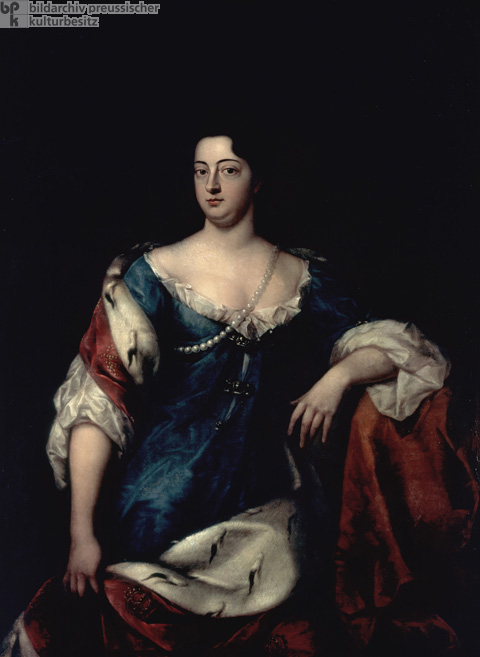
Queen Sophie Charlotte and her interesting chin
When we visited the Charlottenburg palace a couple of days later it was a relief to leave the twentieth century for a while. (I don't suppose the eighteenth century felt particularly innocent for the people who lived in it but it looks that way from a 2014 perspective, for obvious reasons). As a fan of stories and a foe of Information Boards, I do like to have a good audio-guide pressed to my ear when I'm traipsing round a palace, and the Charlottenburg palace audio-guides were really, really engaging. I've just consulted my diary to see what choice pieces of historical information I might share as a result but, aside from a long gush about the quality of the audio-guide, the only pertinent reflection I seem to have made is this: "Queen Sophie Charlotte was considered a great beauty in her day and she does in fact have a pleasant and kindly face, but she also has a big, fat double-chin. Isn't it funny (as in 'interesting') that a chubby face was considered the height of beauty in the 1700s?"


Our Isherwood-esque sitting-room
I am not usually organised enough to read location-specific books when I'm on holiday, but on this occasion I bought a copy of Goodbye to Berlin at the aforementioned museum shop. I had difficulty choosing between that and A Woman in Berlin, but after running my eye over the contents page I plumped for Isherwood because his protagonist's journey from Berlin to Ruegen Island mirrored, rather eerily, our own plans. And it wasn't just the chapter headings that chimed with our holiday. Goodbye to Berlin opens with a description of the narrator's lodgings in an apartment block on a "deep, solemn, massive street," rather like the one we'd rented above a bakery on Windscheidstrasse. We too had a "tall tiled stove, gorgeously coloured, like an altar" in the corner of our bedroom. I kept looking up from the page and feeling a frisson along my spine at the thought that this room had existed (and probably looked much the same) in Christopher Isherwood's day, and inevitably this led me to wonder who had lived here over the last hundred years or so, while Berlin was the epicentre of world history, and what they'd seen and done and undergone.

I'm glad we stayed in that characterful flat and not a could-be-anywhere-in-the-world hotel. It was kitted out with all sorts of odds and ends of furniture - some antique, some plain, some just strange (the non-functioning Bakelite television). Its proportions were big-going-on-majestic compared to most modern flats, as were the double doors that led from room to room, and the ornate mouldings on the ceiling, but there was a vertiginous flight of stairs inside the bathroom door, which made me a bit uneasy about nocturnal trips to the loo, and the walls were papered with woodchip.

The Toothpick
We had both children with us, aged 7 and 10, so while I may have given the impression that I wandered round Berlin ruminating about the eighteenth century feminine ideal and existential questions arising from the Cold War, I spent much more time nagging the kids to eat up their bratwurst and go to the toilet even if they don't feel like it because there won't be any toilets on the bus. My memory of the first full day, which official records state was spent at the Berlin Historiale museum, the Friederichshain park and the DDR museum, was actually spent luring our ten year old out of a very bad mood. First thing in the morning, you see, we'd persuaded her not to squander 18 Euros of her limited pocket money on a whoppingly over-priced  I love Berlin T-Shirt. "We will find a cheaper one somewhere else," we told her, "and you will thank us then". For the next five hours or so (until, at long last, we were vindicated) Berlin passed her by in a dismal blur as the desirability of that relinquished T-Shirt swelled to mythological proportions.Why even try to have fun when you're lumbered for life with bossy, spendthrift, kill-joy parents? Meanwhile the seven year old had forked out 9 Euros on a toy tram and was desperate to get back to the flat so he could run it around on the floor.
Me: Look, that's the television tower, the tallest structure in Germany!
S: Mmm. Can we go back now?
Me: 368 metres high. Wow. It's nicknamed 'the Toothpick.'
S: You do still have my tram safe in your handbag, don't you? Can I just look at it for a teensy second?

Thursday, 14 August 2014

The Dead Hand of Recommendation

In my last post I concluded by raving about Michelle Paver's Dark Matter, and that got me thinking about the problems that come with recommending books. What problems? I hear you say - probably because you have a life to lead and don't allow yourself to get unduly disturbed by life's lesser paradoxes.

Nevertheless, I can't be the only person in the world to have noticed that a gushing book recommendation nearly always results in disappointment. Even if the book in question is good, a teensy bit of frustration seems all-but-inevitable, especially if you're a gullible type who's liable to take other people's effusions very literally. "Your life will never be the same after reading this book", affirms the Arts & Books section of the Saturday paper, so I go to extraordinary lengths to obtain said book and turn to page one with palpitating heart, bidding a fond farewell to my old life as I do so, only to emerge two hundred and forty seven pages later feeling a little flat and thinking "...oh."

On the other hand, being in love with a book is like being in love with a person: cautious language feels pathetic and cold and altogether inadequate. You don't want to say "Hmm..." when you're really thinking, "Yes! Yes! Yes!" so you don't - can't - hold back in your praise. Phrases like "eye-poppingly, mind-bogglingly stupendous" suddenly seem quite tame, and as a result your inflamed listener goes to extraordinary lengths to obtain said book and turns to page one with palpitating heart, bidding a fond farewell to their old lives as they do so, only to emerge two hundred and forty seven pages later feeling a little flat and thinking "...oh."

I suppose there are worse things to lie awake fretting over.

Wednesday, 9 July 2014

Of Ghoulies and Ghosties

It's not really the time of year for ghost stories, but I was given a couple of spine-tinglers for my birthday and hadn't the patience to wait for the requisite long winter nights and crackling fires. Anyway, I need to read ghost stories for 'research purposes', because I am in the middle of writing one.

'Research' is such a pompous word to describe something as fun as reading ghost stories that I almost (almost) feel like a fraud for deploying it. Therefore, just to prove that I have actually been working extremely hard, even when it looked as though I was lying on a picnic rug in a semi-comatose state with a paperback over my face, I hereby present my findings:

The first of the two was This House is Haunted by John Boyne, which is a traditional ghost story set in the nineteenth century, involving all the creepy Victorian fandangles you could possibly desire, including a big, sinister house and some small, sinister children. Personally I would have gone for a more enigmatic title if I was John Boyne, but then again you can't accuse this book of failing to do exactly what it says on the tin. Once our plucky heroine (the new governess, naturellement) has reached Gaudlin Hall, barely a page is allowed to go by without one supernatural shock or another: locked windows fly open, possessed dogs rampage, yokels dispense dire warnings right, left and centre, and ghostly hands try in vain to shove our heroine underneath various forms of moving vehicle, from steam trains to horse-drawn milk floats. I kept imagining a manic, over-caffeinated editor waving the manuscript in the author's face and screeching, "I want to see more action, John! More cliché!You can't have enough cliché!"

In all fairness, the story itself was strong and the whole thing rollicked along pleasurably enough. You will recall, however, that I was not reading it for pleasure but for serious research purposes, and this being the case I feel duty-bound to report the following observations:

a) For the sake of Atmosphere, Flash-Bang-Wallop should be applied sparingly. The best (most menacing) chapter of This House is Haunted was the first one, where newspapers rustled at a gloomy breakfast-table in London and fog swirled abundantly, but nothing awful actually happened.

b) Cliché is a big, big problem for ghostly fiction because, for once, the zero-tolerance approach doesn't work. There must be darkness and a place (yes, it's usually going to be an old, large house) where bad things have happened, and there has to be a protagonist who starts out as an innocent rationalist and ends up changed (i.e.a complete nervous wreck, or dead). There have to be bumps in the night and things half-seen and half-heard...otherwise it's not a ghost story. But how do you stop these fundamentals tipping over into pastiche? (It's a genuine question; I'm not writing as one-who-knows.)There's not much middle-ground between chilling and funny. Take a typical passage from This House is Haunted, and see if you can read it without coming over all Hammer Horror:

"'I'm sure I'll be back often,' I told her.'I'm the new governess at Gaudlin Hall so I expect I will be in and out of the village on a regular basis.'
The moment I said this, the tea cup slipped out of her hands and fell to the floor, smashing into a dozen or more pieces.
'Oh dear,' I said, looking down at it. 'I hope it wasn't valuable.'
Molly, however, was not looking at the broken cup but staring at me instead with a ghastly expression on her face."

In a funny sort of way I love it, but funny is the operative word and it means I'm not scared.

I cannot over-emphasise how enjoyably menaced I was by the second item in my 'research programme', however. I didn't chortle my way through this one, I can tell you. Aside from two snoring kids and a couple of guinea-pigs, I was alone in the house on the night I started reading, and the atmospherics all got a bit much - I had to put it down and read something frivolous instead.

Dark Matter, by Michelle Paver, is set in the 1930s during a long, arctic winter on the island of Svalbard. It's a pretty straightforward story about a scientific researcher enduring months of total darkness on his own after his colleagues abandon him, one after the other, for sinister-yet-plausible reasons. I could outline the entire plot for you in one, short paragraph (don't worry, I wouldn't be such a spoil-sport), but I find it much harder to analyse than the John Boyne novel partly, I suppose, because it's easier to be snide about clunky writing than to understand the workings of something seamlessly brilliant. Anyway, for what they're worth, here are a few thoughts:

a) Dark Matter manages to be classic and original in the same breathe. All the essential components of the ghost story are present and correct, and yet they're given a twist - so for example the creaky haunted house becomes the research station on the bay at Longyearbyen, and the requisite dark palette is provided (in spades) by the arctic winter itself.

b) Atmosphere reigns supreme. Hints are dropped, suspicions are formed, things are glimpsed, but nothing definite happens for quite a long time. It's all about ratcheting up the tension to the nth degree.

c) Place and story are inextricably woven together, so that terror of the ghost and terror of the arctic landscape merge and become the same thing. Michelle Paver's ghost isn't some eccentric apparition wandering around an old house and saying 'Boo' for it's own amusement, it is an integral - even a metaphorical - part of the remorseless winter that Jack endures. I think that's what gives this book such depth. As the days on Svalbard got shorter and shorter, and the darkness started closing in on Jack, I wasn't sure whether I felt claustrophobic for supernatural or non-supernatural reasons (or, indeed, whether that distinction makes much sense. Is it rational or irrational to fear darkness and solitude?)

I'm going to end this post by quoting a passage from Dark Matter, in which Jack records seeing the sun for the very last time before the winter sets in for good:

"Twilight. Behind the bird cliffs, the red glow of dawn, but to the west it was night: the cold glimmer of stars. The black bones of the mountains jutted through the snow. On the shore, the whale ribs glinted with frost, and the rocks sloping down to the sea were white and smooth. The water was dark purple, vivid and strange.
Because of the cliffs, we couldn't see much. We saw the sky turn bloody and inflamed as the sun struggled to rise. We saw a sliver of fire. An abortive dawn. The sun sank back, defeated.
Gone."

Right I'm off to find some more 'research'. Gosh, I'm such a grafter, it can't be healthy. I ought put my feet up for a bit instead and relax with a good book.


Wednesday, 11 June 2014

A Cross-Cultural Exchange

Just now, whilst writing one of the Victorian chapters of my novel, I had an odd experience. I had just positioned my hero in an arm chair, his would-be lady-love standing beside him, when I found myself writing the following sentence: He wrapped his arm around her as he spoke, so that she couldn't move her legs to reach the carafe.

As I read the sentence over I felt a frisson of absolutely genuine horror and thought to myself, Good heavens! What kind of a book is this? You can't go mentioning a woman's...lower limbs...just like that! It's positively obscene! A moment later I came to myself and remembered that twenty-first century folk are used to the idea of women having legs, even to the point of accepting that nineteenth century women had them too, and that my lewd reference was unlikely to cause widespread offence.

I waver between two possible conclusions. On the one hand I may, deep down, be much more seriously repressed than anyone ever knew. On the other hand (and this is obviously my preferred option) maybe, for approximately two seconds of my life, I was mysteriously transmogrified into an actual, real-life Victorian writer with an actual, real-life horror of...you know...female perambulatory equipment.

Wednesday, 7 May 2014

June 19th - I had only got as far as the top of the stairs when...

Alexis Smith as Marian in The Woman in White, 1948
I've been thinking about diaries again: fictional ones, real ones and the ones the fall somewhere in between.

It's partly because I'm at the very, very, earliest stage of a new novel - the vaguely planning to plan a vague plan stage* - and I'm wondering whether to do it (or part of it) in diary form.

I can think of plenty of upsides to writing a fictionalised diary. There's the intimacy of looking over the narrator's shoulder as she sits there, hunched up in bed in her pyjamas, scribbling away. There's the excitement of feeling that the story is happening now; that the narrator is never more than a couple of steps ahead of the reader. There's the way the diarist's perspective is severely limited to the here, the now and the personal - i.e. you can't use retrospective or omniscient wisdom to colour in character and events - which seems to me like a helpful discipline when you're looking to tell a story economically and well.

The main downside of the fictionalised diary (that I can think of) is its artificiality, especially if it's part of a very plot-driven novel. Whilst writing this post I've been flipping through my old copy of The Woman in White by Wilkie Collins. I have such fond memories of reading it aged 15, and in particular the severe diary-envy I suffered whilst reading the melodramatic section that is Marian Halcombe's journal. How come Marian's journal had such a strong narrative drive? How come mine just drifted about from non-event to non-event?  Here is one of Marian's typical daily offerings:

June 19th - I had only got as far as the top of the stairs when the locking of Laura's door suggested to me the precaution of also locking my own door, and keeping the key safely about me while I was out of the room. My journal was already secured with other papers in the table drawer, but my writing materials were left out. These included a seal, bearing the common device of two doves drinking out of the same cup, and some sheets of blotting paper, which had the impression on them of the closing lines of my writing in these pages traced during the past night. Distorted by the suspicion which had now become a part of myself, even such trifles as these looked too dangerous to be trusted without a guard....  
 
As diaries go, it's a far cry from Got up, had breakfast... I was convinced that the fault lay with me and my capacity for writing the wrong bits of life down. Only later on did it dawn on me that Marian Halcombe's diary is A Literary Device.

 
In times of great crisis - when, say, you're urgently trying to work out how to rescue your sister from a lunatic asylum where she's been consigned by her evil husband, having been forced to swap identities with a dead woman to whom she bears an uncanny but as yet unexplained resemblance - are you likely to sit down at regular intervals to write a detailed literary account of everything that's going on, including verbatim accounts of lengthy conversations that will, though you don't know it yet, turn out to be profoundly significant? Are you going to be able to select the details that are relevant to your story and edit out those that aren't, even as they're happening? How do you know that the fact Sir Percival paced uneasily round the drawing room after breakfast is highly suspicious, but the fact he had an extra glass of wine last night is not worth mentioning?

So that's the artificiality problem. But does it matter? It doesn't spoil The Woman in White for me, not even now I'm grown-up and more attuned to such things.

Yes, but just because you can shrug it off in a Victorian novel doesn't mean it wouldn't irritate in a twenty-first century one...

Then again, all fiction is selective and artificial by definition, so why should a melodramatic diary be particularly problematic?

I don't (in case you hadn't guessed) know. But it's the sort of thing I have fun thinking about.


*I love that stage of planning, when absolutely anything is an option and maybe, just maybe, this novel is going to be the next War and Peace. Well, why not? It isn't until I start getting tangible words down onto tangible bits of paper that I come back down to earth with a bump.